
Easter Decor Ideas That Feel Fresh (Not Plastic)
Francisco Barbero
Most Easter decor falls apart the moment you unbox it. Bright plastic eggs, a grinning foam bunny, pastel tinsel that sheds. It looks loud in the store and cheap on the shelf, and about 7 days later you are quietly relieved to box it back up. The good news: the modern Easter decor ideas worth your time go the other direction entirely. Fewer pieces, better materials, softer color. A look that reads grown-up on Sunday and still looks intentional three weeks later. The trick is treating Easter as the opening act of spring, not a one-day costume for your living room.
Here is how to do tasteful Easter home decorating without a single plastic egg: a sophisticated take on pastels, the natural materials that do the heavy lifting, spring wall art ideas you can leave up through May, an honest take on the table, and a light touch at the front door. Expect specifics: the 2/3 rule, 7 frame sizes, a 5-minute table reset.
Modern Easter decor starts with a quieter palette
The fastest way to make Easter look cheap is to crank every pastel to full volume. Candy pink, electric mint, acid yellow, all at once. It reads like a party-supply aisle. The grown-up version dials the saturation down by about 40 to 50 percent and grounds everything in neutrals.
Think duck-egg blue instead of turquoise. Butter yellow instead of lemon. Blush instead of bubblegum. Then anchor those softer tones with cream, oatmeal, pale wood, and a little black or brass so the whole scheme has somewhere to rest. The home design editors at Homes & Gardens make the same case for a pastel base layered with natural texture, which is exactly what keeps spring color from tipping into cute. A 3-color rule helps here. Pick two soft tones and one neutral, repeat them around the room, and stop. Restraint is the entire difference between editorial and Easter clearance.
One more shift: lean on the warm end of the pastel range. Terracotta, sand, sage, and dusty rose feel more current and more adult than the icy candy tones, and they sit better next to wood and linen you already own.
Natural materials do the heavy lifting
If you remember one rule, make it this one: real materials always read as more expensive than plastic, even cheap real materials. A $6 bundle of pussy willow in a plain vase looks more considered than a $30 plastic centerpiece. The texture is what your eye reads as quality.

Stock up on a few of these and you can skip almost everything plastic:
- Woven baskets and rattan. A single rattan tray or a woven basket of eggs does more than a dozen plastic props. It also stores flat and comes back out every year.
- Real or wooden eggs. Painted wooden eggs in muted tones last for decades and never look cheap, whether you buy them finished or paint a few plain ones yourself. For real eggs, skip the neon kit. The Kitchn shows how onion skins, turmeric, beets, and red cabbage dye eggs naturally in soft, earthy colors, and those 4 kitchen ingredients cover most of the pastel range. Simmer with 2 cups water, soak 30 minutes for pastel, up to overnight for deeper tone, and the finished eggs are still safe to eat.
- Moss, twigs, and branches. A small nest of moss and fine twigs holding 3 to 5 eggs is the most elegant Easter vignette there is. Bare branches with early buds add height for almost nothing.
- Linen. A washed-linen runner or a stack of linen napkins instantly cools down a table and reads as the opposite of plastic.
- Fresh stems. Tulips, ranunculus, daffodils, or a few branches of cherry blossom. Three bud vases down a table beat one fussy arrangement.
The throughline is restraint. A few thoughtful natural pieces and some fresh stems will always beat a surface buried in seasonal clutter.
Spring wall art ideas you can leave up through May
This is the piece most people skip, and it is the one that pays off longest. Swapping your walls for the season is the highest-impact, lowest-effort move you can make, and unlike a foam bunny, the right print earns its keep for months. Homes & Gardens puts rotating your artwork with the seasons on its designer list for exactly that reason: a fresh piece resets a whole room the way a gallery rehang resets a wall you had stopped noticing.
For Easter and spring, four directions work especially well:
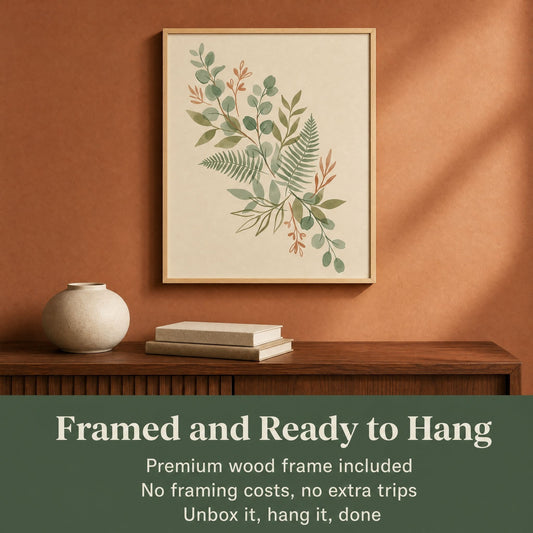
- Botanical and floral prints. Soft watercolor blooms, a single pressed-style stem, or a vintage botanical plate. These say spring without saying Easter, which is exactly why they can stay up from March through June.
- Loose abstracts in spring tones. A wash of sage, blush, and cream carries the season without a single literal motif.
- Pale landscapes and skies. Anything with light, air, and open space reads as the season turning.
- A subtle pastel set. Two or three calm pieces in soft tones, hung as a pair of 16x20 prints or a small trio of 11x14s, do more than one busy bunny print.
Get the scale right and even an inexpensive print looks deliberate. Designers lean on the 2/3 rule: your piece, or a grouping treated as one block, should span about two-thirds (roughly 67 percent) of the width of the furniture below it. For a standard 84-inch sideboard or sofa, that points to roughly 56 inches of art, which is why a 24x36 print or a balanced pair tends to look right. Hang the bottom edge about 6 to 8 inches above the furniture, leaving a 10-inch breathing gap at most. Quality matters as much as size: a piece printed with fade-resistant, archival-quality inks holds its color for years, where thin poster stock curls and yellows within 12 months. Having a full size range up to 28x40, in 4 frame colors, is what makes hitting the right proportion easy instead of a compromise.
The Easter table, done with restraint

An Easter table goes wrong when every element competes. Bunny plates, egg confetti, pastel everything, all shouting at once. The elegant version pulls in one direction and uses fewer, better pieces.
Start with a neutral linen tablecloth or runner and let it set a calm tone. Whether you are laying 4 places or 8, the same logic holds. Add plates you already own, ideally cream, white, or a matte solid, instead of buying a novelty set you will use once. Run 3 to 5 bud vases of single stems down the center rather than one tall arrangement that blocks the conversation. Pair soft pastel linen napkins with whatever flatware you have, and tuck one sprig of greenery or a single dyed egg at each place. That is the whole formula, and it resets in about 5 minutes.
Two finishing touches earn their keep. Taper candles in soft tones add height and warmth for a few dollars. And a small moss nest of eggs in the center doubles as the only Easter-specific object the table needs. Everything else is just spring, which is the point: most of this stays out long after the holiday, so you are not decorating for a single Sunday.
A light touch at the front door
The entryway is the one place a little seasonal signal goes a long way, and it is also where plastic looks worst in daylight. Keep it simple and natural.
A spring wreath of eucalyptus, olive branch, or dried bloom on the door reads as fresh without a single egg in sight, and a 16 to 18-inch faux or dried one holds up through the whole season, not just one weekend. Inside the entry, a woven basket with 3 to 5 stems of forsythia or pussy willow, or a single bud vase on a console under a piece of spring wall art, is plenty. A small pair of ceramic eggs or one understated bunny figure is fine in a modern home. The rule that keeps it tasteful: one or two natural pieces, never a pile. Restraint at the door sets the tone for everything inside.
None of this needs to be a once-a-year buy. The natural materials store flat and return every spring, and the wall art and table pieces can stay up for months. When you are ready to build a look that lasts past one Sunday, browse the floral and botanical wall art pieces, all printed with fade-resistant, archival-quality inks and ready to hang in about 5 minutes the day they arrive on a solid pine frame with a shatterproof front. Free shipping available, along with a 30-Day Money-Back Guarantee.
Frequently asked questions
How do I decorate for Easter without it looking cheap or plastic?
Swap plastic for natural materials: woven baskets, wooden or naturally dyed eggs, moss, linen, and fresh stems. Soften your palette to muted pastels grounded in neutrals, and use fewer pieces. A few thoughtful, real-material touches always read as more expensive than a surface full of plastic props.
What colors look the most grown-up for spring and Easter decor?
Reach for muted, warm pastels rather than candy brights: duck-egg blue, butter yellow, blush, sage, and dusty rose. Anchor them with cream, oatmeal, pale wood, and a touch of black or brass. A simple 3-color rule, two soft tones plus one neutral, keeps the scheme looking editorial instead of cutesy.
What wall art works for spring that I can keep up after Easter?
Botanical and floral prints, soft abstracts in spring tones, and pale landscapes all signal the season without a literal Easter motif, so they stay relevant from March into June. Aim for art that spans about two-thirds the width of the furniture below it, and choose a fade-resistant, archival-quality finish so it holds its color over time.
How do I set a tasteful Easter table?
Start with a neutral linen tablecloth, use plates you already own in cream or a matte solid, and run 3 to 5 bud vases of single stems down the center instead of one large arrangement. Add soft pastel napkins, taper candles, and one small moss nest of dyed eggs. It looks refined and resets in about 5 minutes.
How do I dye Easter eggs naturally instead of using a kit?
Simmer a natural ingredient in 2 cups of water for 15 to 30 minutes, strain, then add 1 tablespoon of white vinegar per cup of liquid. Onion skins give orange, turmeric yellow, beets pink, and red cabbage blue. Soak hard-boiled eggs about 30 minutes for pastel, or up to overnight for richer color.