
Gallery Wall Layout Ideas That Actually Work in Small Rooms
Francisco BarberoMost gallery wall advice assumes you have a massive blank wall to fill. You don't. You have a 6-foot stretch above your couch, a narrow hallway, or a bedroom wall squeezed between two doors. And you're trying to figure out how to make it look good without the room feeling cluttered.
That's what this guide is for. Not the Pinterest fantasy with the 14-foot ceilings. The real version, where you're working with limited wall space and need layouts that actually fit. You'll get specific templates for 3-piece, 5-piece, and 7-piece arrangements, plus the spacing and sizing rules that keep things from looking like a mess. If you want them on paper, our free printable gallery wall templates are drawn to scale with the print sizes, gaps, and hanging heights marked, so you can tape a layout up before a single nail goes in.
Prefer to watch or listen?
The Spacing and Height Rules That Make Everything Else Work
Before you pick a single frame, you need two numbers locked in. These are the foundation everything else builds on.
The first is the 57-inch rule. The center of your art (or the center of your gallery wall grouping) should sit 57 inches from the floor. That's average eye level, and it's the same standard museums and galleries use worldwide. Most people hang their art way too high. This one fix changes everything.
The second is the spacing rule. Keep 2 to 3 inches between frames. Closer than 2 inches and things look crammed. More than 4 inches and the grouping falls apart, especially in a small room where you're already working with limited wall space.
One more thing: if your gallery wall sits above a couch or a bed, forget the 57-inch rule and hang the bottom edge of your lowest frame about 6 to 8 inches above the furniture. This keeps the art connected to the room instead of floating near the ceiling.
Gallery Wall Layout Templates for Small Rooms
The biggest mistake people make is winging it. You end up with holes all over the wall and frames that don't quite line up. These templates take the guesswork out. Pick the one that fits your wall space, then adjust for your specific room.
The 3-Piece Layout (Best for Narrow Walls and Above a Nightstand)

This is where most small rooms should start. Three pieces, one arrangement, zero overwhelm.
Option A: One 11x14" piece centered, with two 5x7" pieces flanking it on either side. Keep everything on the same horizontal center line. Total width runs about 30 inches, which fits perfectly above a nightstand or small desk.
Option B: Three 8x10" pieces in a horizontal row with 2.5 inches between each frame. Total width is about 29 inches. Clean, simple, and hard to mess up. Works well on a small living room wall or in a hallway.
Option C: Stack three pieces vertically. One 8x10" on top, one 5x7" in the middle, and another 8x10" on the bottom. This draws the eye upward and is ideal for walls that are taller than they are wide, like the sliver of wall between a closet door and a bedroom door.
The 5-Piece Layout (Best Above a Couch or Bed)
Five pieces give you enough variety to create visual interest without overwhelming a small room. The key is using an anchor piece.
Start with one larger piece, around 16x20", placed slightly off-center. Then build around it with four smaller frames in a mix of 8x10" and 5x7". Place the two 8x10" pieces diagonally from each other (upper left, lower right, for example) to create balance. Fill the remaining spots with the 5x7" frames.
Keep the total grouping to about two-thirds the width of whatever furniture sits below it. Above a 60-inch couch, that means your gallery wall should span roughly 40 inches. A queen bed is also 60 inches wide, so the same 40-inch target applies there.
Before you put a single nail in the wall, lay everything out on the floor first. Use painter's tape to mark the dimensions of your wall on the floor, then arrange your frames inside that space until the layout feels right. Take a photo with your phone. You'll thank yourself later.
The 7-Piece Layout (Best for a Feature Wall)
Seven pieces is the upper limit for most small rooms. Go beyond that in a tight space and the wall starts to feel chaotic instead of curated.
A good 7-piece layout uses one 16x20" anchor, two 11x14" supporting pieces, two 8x10" pieces, and two 5x7" pieces. Place the anchor piece in the center (or slightly off-center for a more relaxed look), position the 11x14" pieces on opposite sides at slightly different heights, then fill in the gaps with the smaller frames.
Total width: about 48 to 54 inches. Total height: about 36 to 42 inches. That fills a decent stretch of wall without crowding the room.
Mix vertical and horizontal orientations. If all your pieces are the same orientation, the whole wall reads as a grid rather than a gallery. Two or three vertical pieces mixed with horizontal ones breaks up the pattern and keeps the eye moving.
How to Arrange Gallery Walls Without Making the Room Feel Smaller
This is the anxiety most people feel and almost no gallery wall guide addresses head-on. Will putting a bunch of frames on the wall make my small room feel even smaller?
Short answer: no, if you do it right. A well-arranged gallery wall actually draws the eye upward and creates a focal point, which makes the room feel more intentional (and often larger) than a blank wall does.
Here's what helps:
Use mats inside your frames. A white mat around a smaller print adds visual breathing room without adding more frames to the wall. An 8x10" frame with a mat for a 5x7" print gives you the presence of a larger piece without the weight.
Pick a color palette and stick with it. Two or three colors across all your prints, or go all black and white for a clean, gallery-style look. When the colors tie together, the grouping reads as one piece rather than a collection of random stuff.
And think about your frames. Matching frames (all black, all white, or all natural wood) create order. Mixing frame styles works too, but in a small room, limit yourself to two frame finishes. More than that in a tight space starts to feel busy.
Frame Sizes and Styles That Work Best in Small Spaces

Smaller frames like 5x7" and 8x10" are your workhorses in a small room. They're big enough to show detail but small enough to fit multiples on a tight wall. For your anchor piece, go up to 11x14" or 16x20", but probably not bigger unless you're doing a single statement piece instead of a gallery wall.
Sleek, slim frames work better than chunky ones. A 14mm frame profile gives you a finished look without eating into your wall space. If you want something more substantial for an anchor piece, a chunkier frame profile adds a premium feel without overwhelming the arrangement.
Material matters more than most people realize. Solid wood frames (pine, for example) have weight and presence that you can feel when you pick them up. MDF and plastic frames, the kind you find in most gallery wall sets on Amazon, feel light and flimsy by comparison. The difference is obvious on the wall, especially up close.
For the front, shatterproof plexiglass is worth looking for over regular glass. It's lighter (which matters when you're hanging multiple pieces), safer if something gets bumped in a tight space, and it doesn't glare as much in rooms with limited natural light.
Small Gallery Wall Ideas by Room
Different rooms call for different approaches, even when the wall space is similar.
Living room: The wall above the couch is the classic gallery wall spot. Use the 5-piece or 7-piece template and keep the total width to two-thirds of your couch. If you're browsing for prints, our living room wall art collection has pieces sized for exactly this kind of arrangement.
Bedroom: Above the bed, keep it calm. A 3-piece horizontal layout or a symmetrical pair of 11x14" prints works well. Avoid anything too busy or colorful if this is a space where you're trying to wind down.
Hallway: Narrow hallways are actually perfect for vertical gallery walls. Stack 3 to 5 pieces in a column, following the path of foot traffic. You can also stagger frames at slightly different heights along the wall's length for a collected-over-time look.
Staircase: Follow the angle of the stairs. Place frames so their center points create a line that runs parallel to the handrail. Start with your largest piece at the bottom and use smaller frames as you go up. A staircase gallery wall is one of the best ways to fill an awkward wall that nothing else fits on.
Home office or studio: This is where you can get personal. Mix art prints with photos, postcards, or small objects. A 5-piece layout on the wall you face while working gives you something to look at that isn't a screen.
Matching Frames vs. Mixing: What Works in Small Rooms
Both work. But in a small room, matching frames have an edge because they create visual calm. All-black frames with white mats? That looks intentional in any space, regardless of what art you put inside them.
If you prefer to mix, keep it controlled. Two frame colors maximum (black and natural wood is a classic combo). And keep the frame widths similar so the collection reads as a group, not a random assortment.
One approach that works well: use the same frame for your 3 to 5 smaller pieces, then pick a slightly different (but complementary) frame for your anchor piece. It gives the anchor weight without breaking the cohesion.
How to Hang Your Gallery Wall (Without 30 Extra Holes)
The paper template method saves walls and marriages. Cut pieces of kraft paper or newspaper to the exact size of each frame. Tape them to the wall with painter's tape and rearrange until the layout looks right. Then mark your nail spots through the paper, remove it, and hang. Interior designers use this approach to avoid the trial-and-error holes that come from eyeballing it.
Start with your anchor piece first, then work outward. Hang the largest piece, step back, and position each smaller piece relative to it. Keep a tape measure handy and check your spacing as you go. It sounds tedious, but 10 minutes of measuring saves an hour of hole-patching later.
For renters or anyone who doesn't want to commit to nail holes, command strips work for lighter frames. Just check the weight rating, frames with solid wood and plexiglass can run heavier than the cheap gallery sets, so you might need the larger strips.
Ready-Made Gallery Wall Art vs. DIY Collecting
There are two paths to building a gallery wall. Collecting individual pieces over time (the slow, personal route) or buying a coordinated set of prints that are designed to go together.
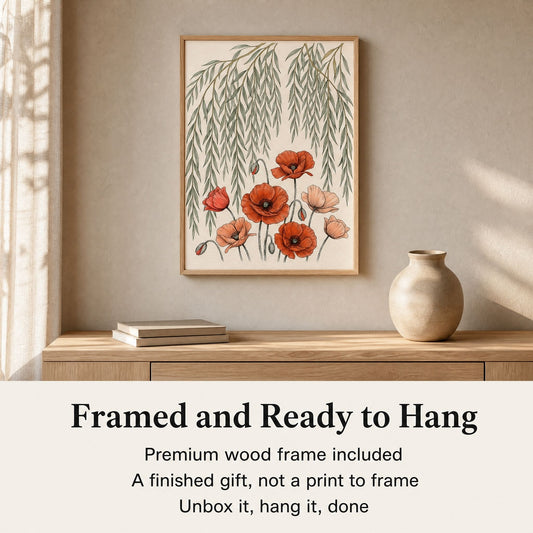
If you want something on your wall this week, ready-to-hang art is the faster path. Look for pieces that ship already framed with hardware attached, so you're hanging the same day the box arrives. At Sparkycare, our framed prints are made for this: fade-resistant, archival-quality inks in solid pine frames with shatterproof plexiglass. Every piece comes ready to hang. No trips to the frame shop.
If you'd rather collect over time, start with your anchor piece and add to the layout as you find things you love. The 3-piece layout is a perfect starting point because you can always expand it to 5 or 7 pieces later without starting over.
Frequently Asked Questions

How many pieces should a gallery wall have in a small room?
Three to seven pieces is the sweet spot for most small rooms. Three pieces work for narrow walls and above nightstands. Five pieces fill the space above a couch or bed nicely. Seven is the upper limit before a small room starts to feel cluttered. Start with fewer and add more later if the wall can handle it.
How far apart should frames be on a gallery wall?
Keep 2 to 3 inches between frames. This spacing is tight enough that the grouping reads as one unit, but open enough that each piece gets its own breathing room. In small rooms especially, consistent spacing keeps things looking organized rather than chaotic.
Will a gallery wall make my small room look smaller?
No. A well-planned gallery wall actually creates a focal point that gives the room structure. The key is keeping the layout proportional to the wall (use the two-thirds rule relative to furniture below) and sticking to a cohesive color palette. A blank wall doesn't make a room feel bigger. It just makes it feel unfinished.
Should all gallery wall frames match?
They don't have to, but matching frames do create a cleaner, calmer look, which helps in a small room. If you want to mix, limit yourself to two frame finishes (like black and natural wood) and keep the frame widths similar. The goal is for the collection to read as a group, not a yard sale.