
What Was the Moon Phase When You Were Born?
Francisco BarberoYou want to know what the moon looked like on the day you were born. Maybe it is your own birthday, maybe it is a partner's, maybe it is the night a baby arrived. Your birth moon phase takes about two minutes to find, and you need only three things: the date, the place, and the time if you have it.
The catch is that many date-only moon calculators get one case wrong, and plenty of people fall into it. Below is how to look your moon up properly, what each of the eight phases looked like in the sky, why the moon is turned over south of the equator, and what people mean when they talk about the meaning of a birth moon.
How to find your birth moon phase
Start with the birth certificate or a hospital bracelet if you have one, because the time matters more than people expect. Then:
- Write down the date, the town and the time. Use the local time where the birth happened, not the time where you live now.
- Look up the phase for that date. The US Naval Observatory's moon phase tables list the exact moment of every new moon, first quarter, full moon and last quarter, year by year. Find the two that sit either side of the birth date and you know where in the cycle it fell.
- See the moon itself. NASA's Dial-A-Moon shows a picture of the moon for any date and hour, with the percentage lit. Type the date and time, and you are looking at your moon.
The moon goes through its whole cycle of phases every 29.5 days, according to NASA's guide to moon phases. So two people born a month apart can share a phase, while two people born a week apart never do.
The one mistake that gives you the wrong moon
Many calculators work in Universal Time, the clock kept at Greenwich. That is fine for a birth in the morning. It goes wrong for anyone born in the evening in the Americas.
Take a baby born at 9:30 pm on October 6 in Los Angeles. In Universal Time that moment is already October 7. A calculator that reads only the date and assumes Universal Time shows you the moon of the wrong evening. Most of the time the picture barely changes. Around a first or last quarter, though, the lit part grows or shrinks by about 10 percentage points a day, and a day's slip can move you from one named phase to the next.
The fix is simple. Use a tool that asks for the time and the place, or check the Naval Observatory table yourself and remember that its times are in Universal Time too. If the birth was close to midnight, check both dates.
The eight moon phases, and what yours looked like

Four of the phases are exact moments: new moon, first quarter, full moon and last quarter. The other four are the stretches in between, each lasting roughly a week. Here is what each one looked like from the northern half of the world:
- New moon: almost nothing to see. The moon sits close to the sun and its dark side faces us. A birth at a new moon came under a sky lit by stars alone.
- Waxing crescent: a thin curve of light on the right, growing each evening, seen low in the west after sunset.
- First quarter: the right half lit, high in the sky at sunset.
- Waxing gibbous: more than half lit and swelling toward full, bright through the evening.
- Full moon: the whole face lit, rising as the sun sets and up all night.
- Waning gibbous: still bright, now losing light on the right, rising later each night.
- Last quarter: the left half lit, often still up in the morning sky.
- Waning crescent: a thin curve on the left, seen before dawn.
A good lookup gives you a percentage as well as a name, and the number is often the better detail. "Waxing gibbous, 87% lit" tells you far more about the sky that night than "gibbous" on its own.
Why the moon looks turned over south of the equator
The phase is the same everywhere on Earth at the same moment. The picture is not. Someone standing in Sydney or Buenos Aires sees the moon upside down compared with someone in New York or London, so a waxing moon there is lit on the left, not the right. Near the equator a crescent often lies on its back, like a bowl.
Most moon phase pictures online are drawn for the northern half of the world. If you were born in Australia, South Africa, Argentina or anywhere else south of the equator, flip the picture in your head, or find one drawn for your place. It is a small thing, and it is exactly the kind of detail the person you are giving it to will notice.
What is the rarest moon phase to be born on?
The four exact phases. A full moon, for example, happens at one instant, so only the calendar day that holds that instant gets the label. That is about 1 day in every 29.5, or a little over 3% of birthdays, and the same goes for the new moon and the two quarters. The four in-between phases each cover close to a week of the cycle, so most people are born under a crescent or a gibbous moon.
What does your moon phase at birth mean?
Astronomy gives you the phase. The meaning comes from astrology. The astrologer Dane Rudhyar described eight "lunation types", one for each phase, and most birth moon readings online still follow his outline: new moon births as beginners and starters, full moon births as people who see things clearly and in public, and the waning phases as givers of what they have learned.
Whether you take that seriously or not, the part that holds up is the simpler one. The moon on the day someone arrived, or the day two people married, really was that shape, in that sky, over that town. That is reason enough to keep it.
Keeping the moon of the day
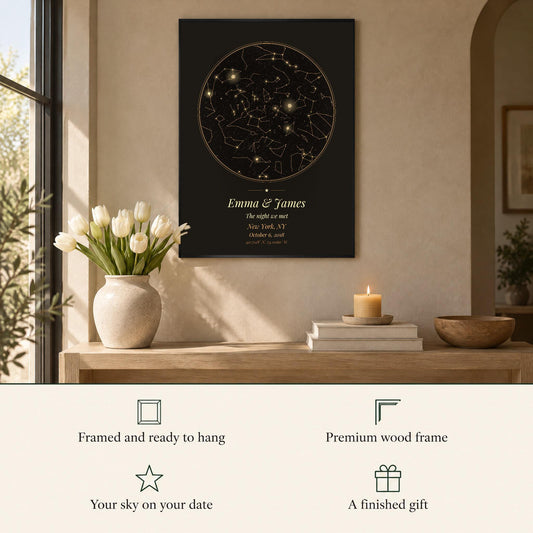
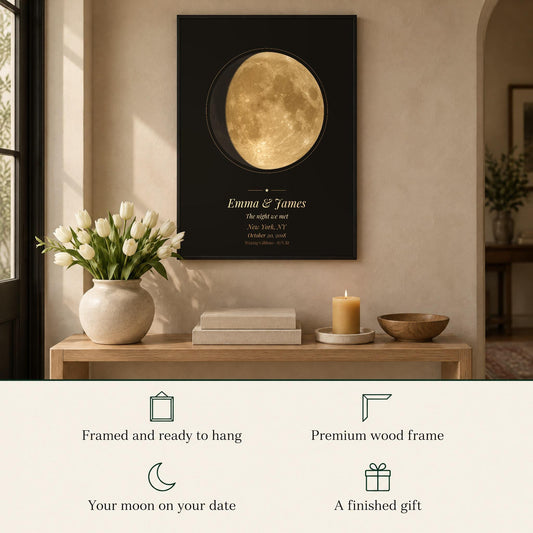
Once you know your moon, it makes a quiet, personal thing to hang on the wall. Our moon phase prints draw the moon for your date and place, lit on the side people there really saw, with the phase and the percentage lit printed beneath your names. If you would rather keep the whole sky of that night, the same page holds our star maps, and each has a version with the moon added. You can see both on our custom star map and moon phase prints page.
Frequently asked questions
How do I know which phase of the moon I was born in?
Look up your birth date, local time and town in a moon phase table or a calculator that asks for the time. The US Naval Observatory lists every new, first quarter, full and last quarter moon by date; your birthday falls between two of them, and that tells you the phase.
What's the rarest moon phase to be born on?
The four exact phases: new moon, first quarter, full moon and last quarter. Each falls on about 1 day in 29.5, a little over 3% of birthdays. The crescent and gibbous phases in between each last close to a week, so they are far more common.
Can I see the moon on my birthday on a NASA site?
Yes. NASA's Dial-A-Moon, part of its Moon Phase and Libration gallery, shows a picture of the moon for any date and hour you type in, with the percentage of the face lit. It is drawn for the northern half of the world, so flip it if you were born south of the equator.
What is the luckiest phase of the moon?
Astronomy has no lucky phase; every phase is the same moon lit from a different angle. In folklore and astrology the waxing phases, from new moon to full, are the ones linked with growth and good beginnings, which is why many people choose them for weddings and launches.
Found your moon? Keep it where you will see it every day. Start with our custom star map and moon phase prints, or if the date is a wedding anniversary, browse our anniversary gifts by year.